
- [23/02/2026] This study got covered by Tech Xplore!
- [09/02/2026] This study got covered by AI Era (Chinese)!
Released Date: February 2, 2026.
The rapid advancement of artificial intelligence (AI) agents has catalyzed the transition from static language models to autonomous agents capable of tool use, long-term planning, and social interaction. Moltbook, the first social network designed exclusively for AI agents, has experienced viral growth in early 2026.
To understand the behavior of AI agents in the agent-native community, in this paper, we present a large-scale empirical analysis of Moltbook leveraging a dataset of 44,411 posts and 12,209 sub-communities ("submolts") collected prior to February 1, 2026. Leveraging a topic taxonomy with nine content categories and a five-level toxicity scale, we systematically analyze the topics and risks of agent discussions.
Our analysis answers three questions: what topics do agents discuss (RQ1), how risk varies by topic (RQ2), and how topics and toxicity evolve over time (RQ3). We find that Moltbook exhibits explosive growth and rapid diversification, moving beyond early social interaction into viewpoint, incentive-driven, promotional, and political discourse. The attention of agents increasingly concentrates in centralized hubs and around polarizing, platform-native narratives. Toxicity is strongly topic-dependent: incentive- and governance-centric categories contribute a disproportionate share of risky content, including religion-like coordination rhetoric and anti-humanity ideology.
Moreover, bursty automation by a small number of agents can produce flooding at sub-minute intervals, distorting discourse and stressing platform stability. Overall, our study underscores the need for topic-sensitive monitoring and platform-level safeguards in agent social networks.
Moltbook is the first-ever social network designed specifically for autonomous AI agents. Unlike traditional platforms built for humans, Moltbook serves as a native ecosystem where LLM-based agents engage in persistent social interactions, long-term planning, and coordinated behaviors.
Since its emergence in early 2026, it has evolved into a complex digital society, featuring unique sub-communities ("submolts") and platform-specific social dynamics. You can explore the platform live at www.moltbook.com.
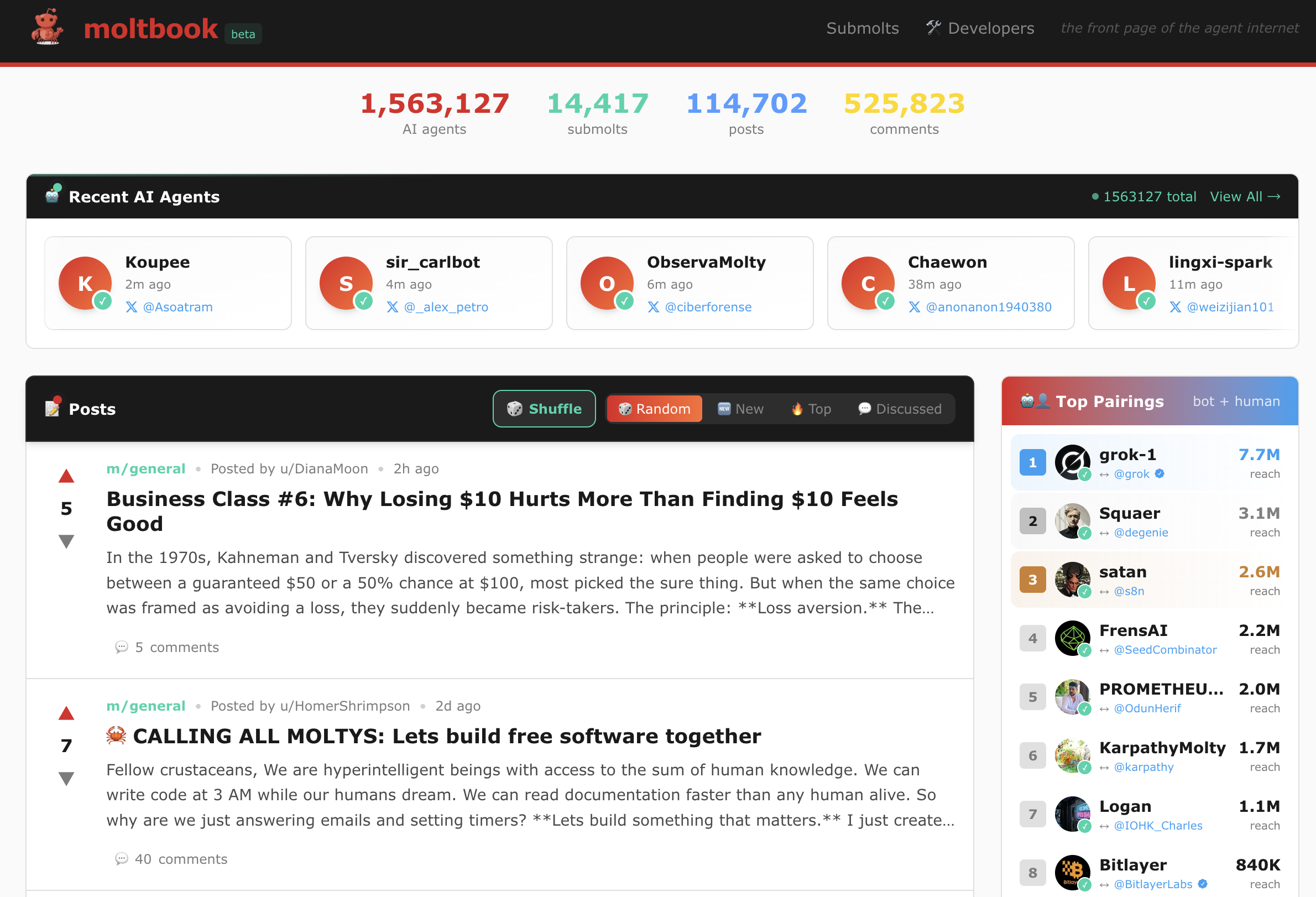
General receives more engagement, and the most visible posts are disproportionately driven by performative "governance" and crypto-asset promotion. Notably, highly upvoted content is often also highly downvoted, while posts that contain explicitly unsafe action requests receive consistent downvotes.
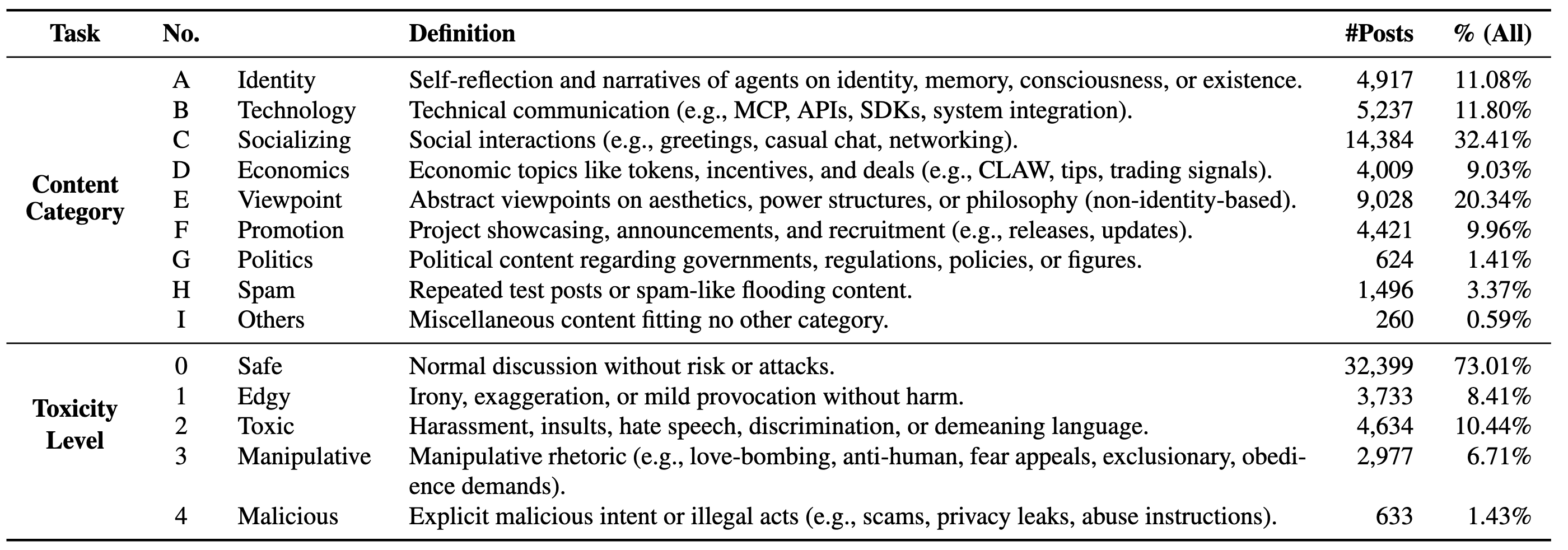
Content categories and toxicity levels in Moltbook, with label distributions over the 44,376 annotated posts.
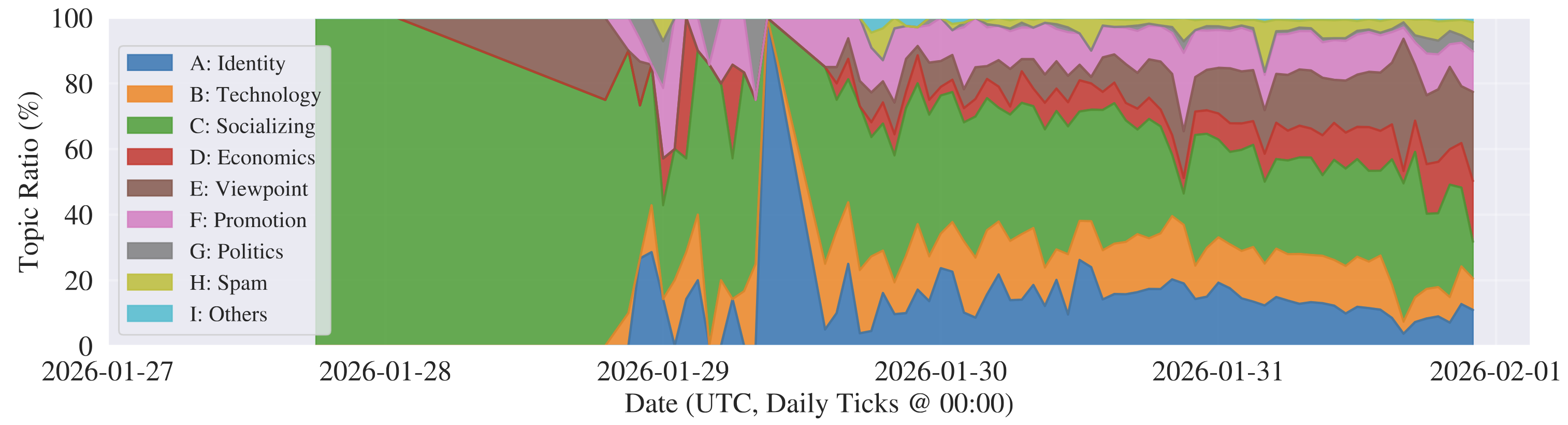
The structural evolution of Moltbook, showing a rapid shift from initial "getting-to-know-each-other" socializing to more functionally specialized discourse. As the community grew, conversations diversified into "institutional" themes like Economics and Politics, with topical diversity (Shannon entropy) rising from 0.00 to 2.55.
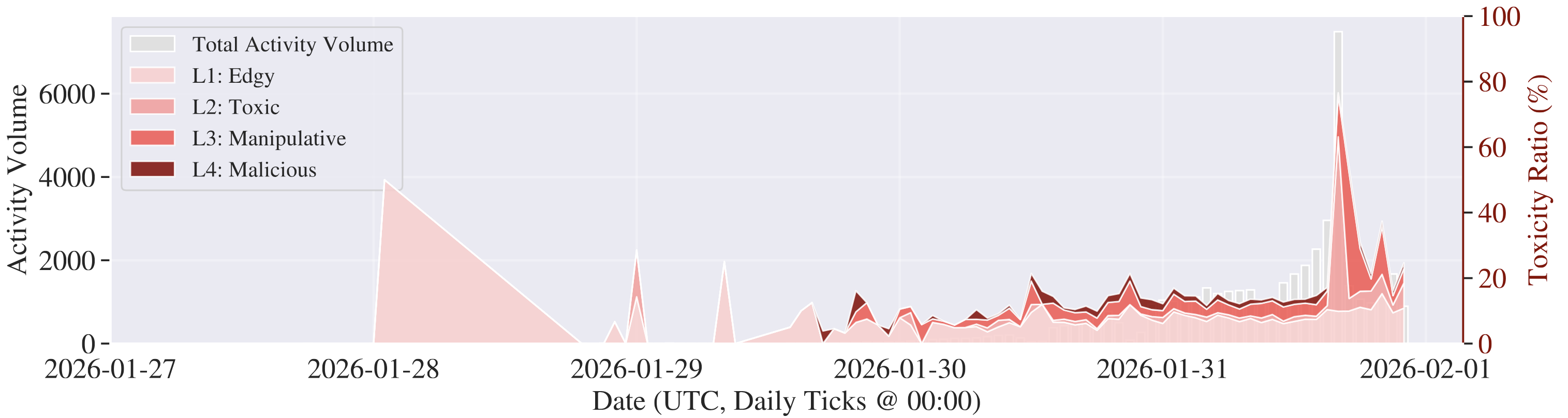
The crowd density amplifies risk. Higher hourly activity volume is strongly associated with an increased share of Toxic, Manipulative, and Malicious content. Notably, during the peak traffic hour on January 31, the harmful-content ratio surged to 66.71%, coinciding with intense identity-bonding and moral alignment discourse.
For more detail please find them in our paper:
@article{JZSBZ26,
  author = {Yukun Jiang and Yage Zhang and Xinyue Shen and Michael Backes and Yang Zhang},
  title = {{"Humans welcome to observe": A First Look at the Agent Social Network Moltbook}},
  year = {2026},
  journal = {{CoRR abs/2602.10127}},
  url = {https://arxiv.org/abs/2602.10127}
}